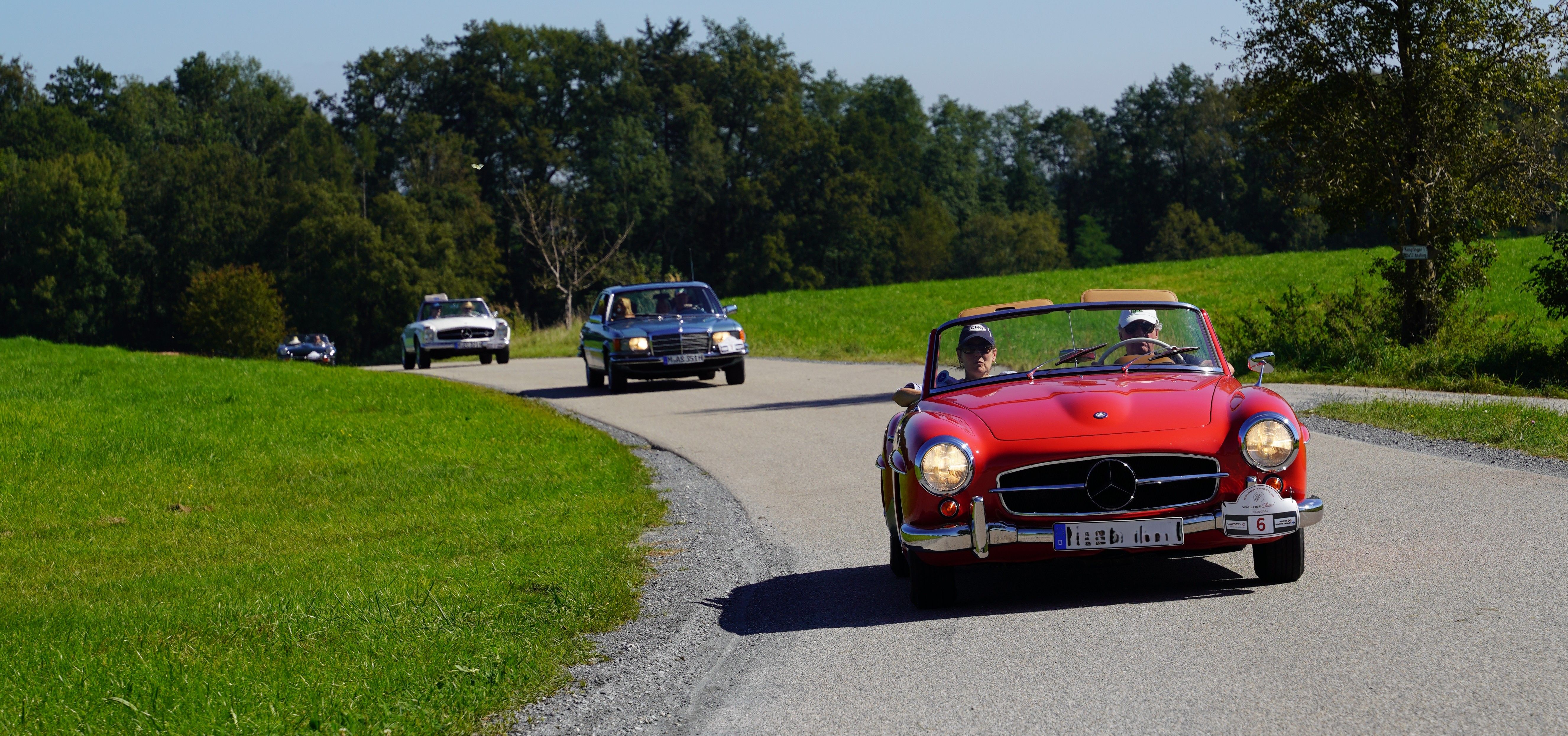
Anyone who owns a Mercedes 190 SL, a Pagoda, or a W111 coupe or convertible is familiar with the question: How often should I ride? Is using it as little as possible better for maintaining its value - or does leaving it unused for long periods of time do more harm than taking regular rides?
The good news: A classic car will thank you for driving it. What matters isn't how muchyou drive, but how you drive. With proper use, you can prevent damage caused by sitting idle, maintain the car's technical condition, and reduce unnecessary wear and tear.
A classic car isn't just a showpiece. Seals, bearings, brakes, and the entire drivetrain will only stay in good condition if they're regularly in motion.
Drives every two to four weekshave proven effective. Routes of 40 to 80 kilometersare ideal, as they allow the engine to reach full operating temperature.
Short trips to the bakery or around town, on the other hand, aren't very practical. They often result in condensation and fuel residues remaining in the engine oil. Over time, this can increase wear and tear.
Most engine wear occurs in the first few minutes after startup.
Therefore:
This is much gentler on the bearings, pistons, and valve train than letting the engine warm up for a long time while stationary.
The classic Mercedes inline-four and inline-six engines perform best in the mid-range.
Driving at low RPMs is just as detrimental as consistently high RPMs. For example, if you drive up a hill at 1,500 RPM in a high gear, you’re putting more strain on the engine than you would at a slightly higher RPM in a lower gear.
For many classic Mercedes models, the most comfortable range is between 80 und 100 km/h.
Within this speed range, the engine, transmission, and drivetrain operate particularly smoothly. At the same time, oil temperature, noise levels, and mechanical stress remain low.
Higher speeds are sometimes not a problem. However, driving at full throttle for extended periods significantly increases temperature and wear and tear.
Many owners drive their classic cars exclusively with extra care. That sounds logical—but it isn't always the best approach.
Once the engine is fully warmed up, it doesn't hurt to accelerate a little more vigorously from time to time. This helps reduce deposits in the combustion chamber and keeps the piston rings moving smoothly.
Of course, the same applies here: use good judgment.
Driving in the rain is generally not a problem, as long as the vehicle can dry off properly afterward.
Road salt, on the other hand, is the greatest enemy of classic Mercedes cars. The corrosion protection on cars from the 1950s and 1960s does not measure up to that of modern vehicles.
If you want to preserve as much of the original condition as possible over the long term, it’s best to avoid driving on salt-treated roads.
Classic cars like to be driven.
If a vehicle remains stationary for several months, the following problems, among others, may occur:
Ideally, you should not leave the car unused for more than four to six weeks .
Many classic cars are driven only a few thousand kilometers a year. Nevertheless, engine oil degrades over time.
Therefore, we recommend:
Schmieren Sie alle Schmierstellen gemäß dem Wartungsplan.
Many owners wonder whether keeping the mileage as low as possible helps preserve the car's value.
In fact, experience shows otherwise.
About 2,000 to 3,000 kilometers per year is considered a very good range
Drivers who drive significantly less are more likely to experience damage caused by the car sitting idle. Drivers who cover tens of thousands of kilometers each year naturally increase wear and tear.
Regular, relaxed rides are therefore usually the best solution.
A Mercedes 190 SL, a Pagoda, or a W111 was built to be driven—not to sit idle in the garage for years on end.
Die beste Strategie für den langfristigen Werterhalt ist denkbar einfach:
This way, the technology, driving pleasure, and original condition are preserved for many years—and your classic car will reward you with reliability and stable value.
And, of course, you should also look for the right garage or parking space to help maintain your car’s value. If you want the ideal solution, park your car at the WALLNERWERK vehicle storage facility, where 24/7 access means you can take it for a spin anytime—all under the best conditions.