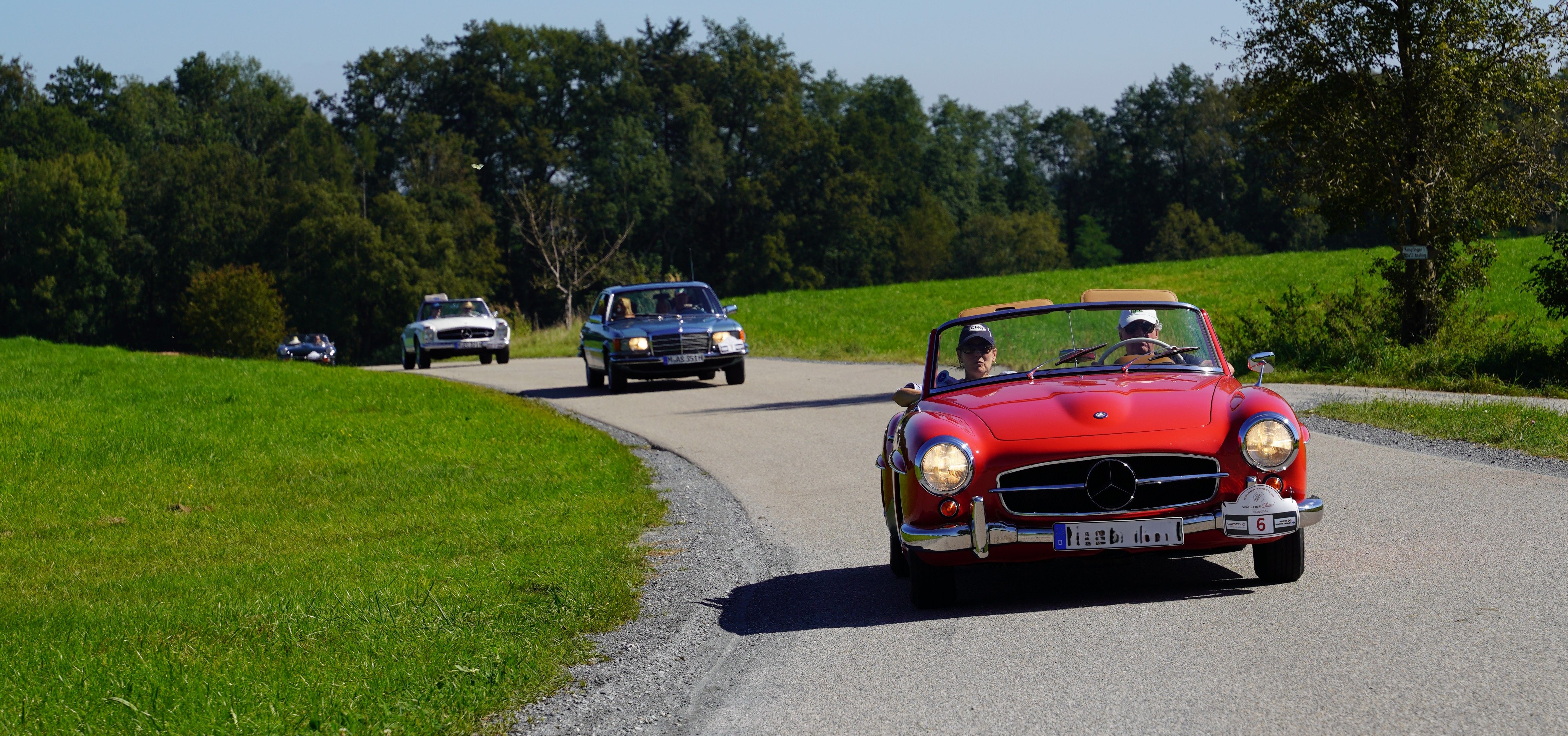
Anyone who owns a Mercedes 190 SL, a Pagoda, or a W111 coupe or convertible has asked themselves this question: How often should I drive it? Is driving as little as possible better for preserving its value—or does leaving it parked for long periods of time do more harm than taking it out for regular drives?
The good news is that a classic car will thank you for keeping it on the road. What matters isn’t how much you drive, but how you drive. With proper use, you can prevent damage caused by prolonged inactivity, maintain the car’s technical condition, and reduce unnecessary wear and tear.
A classic car isn’t just a display piece. Seals, bearings, brakes, and the entire drivetrain will only stay in good condition if they’re regularly in motion.
Drives every two to four weeks have proven effective. Ideal distances are 40 to 80 kilometers, allowing the engine to fully reach operating temperature.
Short trips to the bakery or around town, on the other hand, are not very helpful. They often result in condensation and fuel residues remaining in the engine oil. Over the long term, this can increase wear and tear.
Therefore: Start the engine and begin driving after a few seconds.
Do not let the engine warm up while idling for several minutes. Drive with only a light load for the first 10 to 15 kilometers.
Avoid high RPMs and full throttle until the engine is fully warmed up. This protects the bearings, pistons, and valve train much better than letting the engine idle for a long time.
The classic Mercedes inline-four and inline-six engines perform best in the mid-range. Driving at low RPMs is just as detrimental as consistently high RPMs.
For example, driving up a hill at 1,500 RPM in a high gear puts more strain on the engine than doing so at a slightly higher RPM in a lower gear.
For many classic Mercedes models, the most comfortable speed range is between 80 and 100 km/h.
Within this speed range, the engine, transmission, and drivetrain operate particularly smoothly. At the same time, oil temperature, noise levels, and mechanical stress remain low.
Higher speeds are occasionally no problem. However, driving at full throttle for extended periods significantly increases temperature and wear.
Many owners drive their classic cars exclusively with extreme caution. That sounds logical—but it isn’t always the best approach.
Once the engine is fully warmed up, it doesn’t hurt to accelerate a bit more vigorously from time to time. This helps reduce deposits in the combustion chamber and keeps the piston rings moving smoothly.
Of course, the same rule applies here: use good judgment.
Driving in the rain is generally not a problem, as long as the vehicle can dry off properly afterward.
Road salt, on the other hand, is the greatest enemy of classic Mercedes models. The corrosion protection in cars from the 1950s and 1960s does not match that of modern vehicles.
If you want to preserve as much of the car’s original condition as possible over the long term, it’s therefore best to avoid driving on salt-treated roads.
If a vehicle sits unused for several months, the following problems—among others—can occur:
seals that harden or dry out,
carbon buildup in the carburetor,
surface rust on brake rotors or drums,
fuel degradation,
corrosion caused by condensation.
Ideally, you should not leave the car unused for more than four to six weeks.
Many classic cars are driven only a few thousand kilometers per year. Nevertheless, engine oil degrades over time.
Therefore, we recommend:
an annual engine oil change,
brake fluid replacement every two years,
regular coolant changes,
checking valve clearance,
synchronizing the carburetors (if necessary),
lubricating all lubrication points according to the maintenance schedule.
Thorough maintenance usually costs significantly less than repairs down the road.
Many owners wonder whether driving as little as possible helps preserve the car’s value.
In fact, experience shows otherwise.
About 2,000 to 3,000 kilometers per year is considered a very good range.
Those who drive significantly less are more likely to risk damage from the car sitting idle. Those who drive tens of thousands of kilometers each year naturally increase wear and tear.
Regular, leisurely drives are therefore usually the best solution.
The best strategy for preserving value over the long term is remarkably simple:
This way, the car’s mechanical condition, driving pleasure, and original condition are preserved for many years—and your classic car will reward you with reliability and a stable value.
And, of course, you should also look for the right garage or parking space to help preserve its value. If you want the ideal solution, park your car at the WALLNERWERK vehicle storage facility, where 24/7 access means you can take it for a spin anytime—all under the best possible conditions.